
Catoosa County Criminal Court Cases
Catoosa County criminal cases divide by charge and jurisdiction. Superior Court hears felonies and keeps indictments, permitted accusations, motions, pleas, verdicts, sentences, and related orders. State Court hears misdemeanors and traffic matters. Magistrate Court handles warrants, first appearances, and preliminary matters, but that early activity does not always become the final trial-court file. Juvenile cases follow a restricted access framework. Each clerk controls the file for the court it serves.
Ringgold and Fort Oglethorpe municipal courts keep qualifying ordinance, traffic, and misdemeanor cases within their city systems. A searcher who assumes every Catoosa County criminal court case appears in one county index can miss a city matter. Federal prosecutions also sit outside the local system. Identify the charging court on a citation, bond paper, notice, or prior docket entry before requesting a certified copy.
The location of the arrest does not by itself name the trial court. A Ringgold address may point to a city citation, a county misdemeanor, or a Superior Court felony. Start with the court printed on the latest official paper. When that is unavailable, the alleged charge level and arresting agency can help the clerk route the inquiry without treating a guess as fact.
Catoosa Court Levels by Charge
The filed charge determines where the lasting court record lives. A jail intake label does not settle that point because the prosecutor may decline, amend, merge, or replace the arrest charge. Superior Court is the felony-level trial court. State Court is the main county forum for misdemeanors and traffic cases. A municipal clerk remains the first contact when the case arose under Ringgold or Fort Oglethorpe authority.
| Court | Main criminal work | Best record contact |
|---|---|---|
| Superior Court | Felony filings, pleas, trials, dispositions, and sentences | Clerk of Superior Court |
| State Court | Misdemeanors, traffic, and related county matters | State Court clerk |
| Magistrate Court | Warrants, first appearances, and preliminary functions | Magistrate clerk |
| Municipal courts | City ordinances, traffic, and qualifying misdemeanor matters | Ringgold or Fort Oglethorpe court |
Searching Catoosa County Case Records
Begin with the official Catoosa CM Web Search. Accept its public-service disclaimer, then search the court index. The clerk warns through the portal that it is a convenience copy, not a certified record. Questions about the local search may be directed to 706-935-4231. Georgia has no single comprehensive public search for every trial court, but the Georgia Courts E-Access directory can route readers to participating systems.
- Choose the CM Web search route that matches the known detail, such as a party or case number.
- Enter the most exact name available, then try reasonable spelling forms if the first search fails.
- Compare court, case type, filing date, and party details before opening a result.
- Read docket events in order, but do not infer an outcome from a charge label alone.
- Ask the proper clerk for a copy or certified disposition when the result will be relied upon.
| Search detail | Format | Required | Use |
|---|---|---|---|
| Party name | Text | Depends on search tab | Find cases tied to a displayed defendant name |
| Case number | Text | Depends on search tab | Open a known Catoosa County case directly |
| Court or case type | Filter | No | Separate felony, misdemeanor, and other files |
| Filing date or year | Date filter | No | Narrow common names and long result lists |
| Case status | Displayed result | No | Distinguish pending and closed entries, subject to clerk confirmation |
When Catoosa CM Web Misses
A blank CM Web result is not proof that no court matter exists. A very new booking may not have reached a filed and indexed case. A city matter may stay in municipal court. Older, sealed, restricted, federal, or misindexed files may not appear in the same view. Search spelling variants and confirm the likely court before drawing a conclusion.
The official portal interface is shown in the clerk's CM Web Search source.
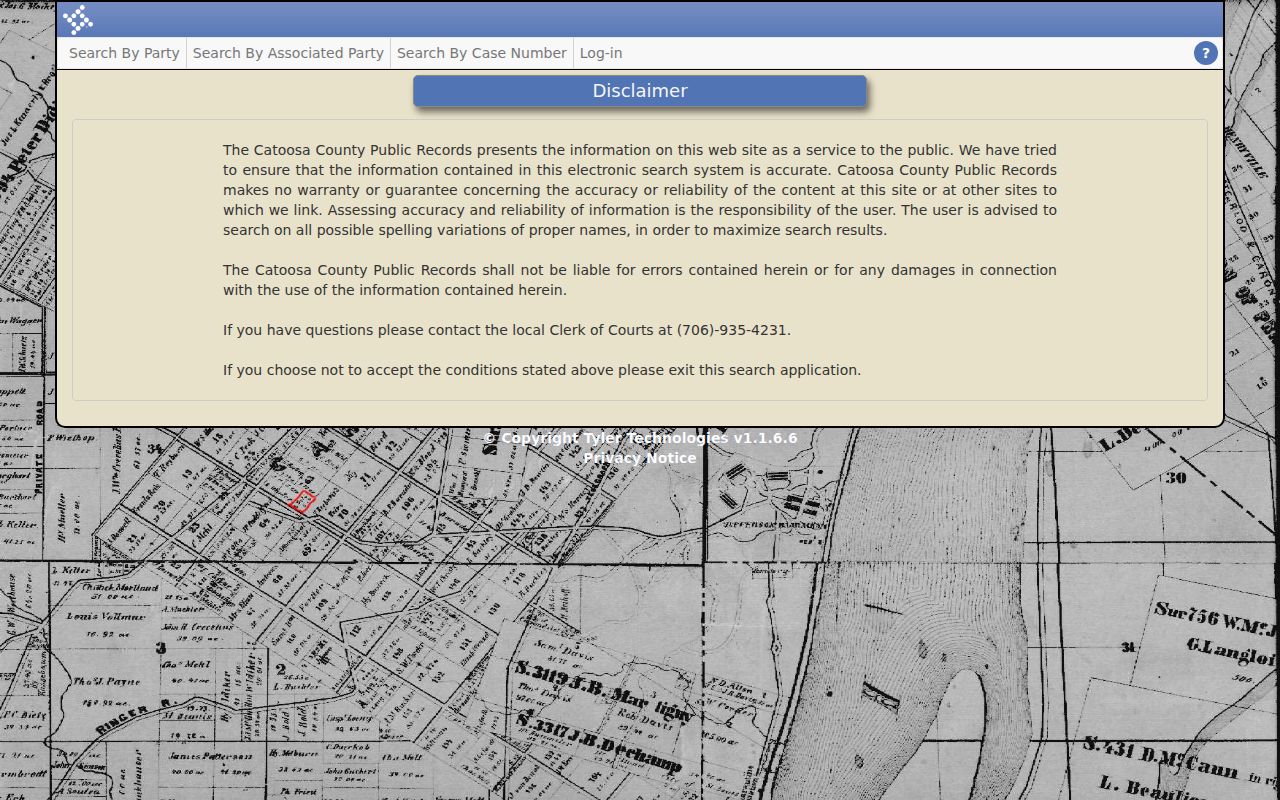
Use the image as an orientation point, then follow the live portal because labels and available records can change.
Recently filed Catoosa County cases deserve extra care. A booking can precede prosecutor review and clerk indexing. Search again after filing has had time to occur, then call the clerk if the matter remains absent. Give the arrest date and agency as context, but ask the clerk to confirm whether a case number exists rather than demanding a match to the original intake charge.
Inside a Catoosa County Case File
A Catoosa County criminal case file traces what the prosecutor filed and what the court did. It can show an accusation or indictment, arraignment, motions, calendars, pleas, orders, disposition, sentence, and later probation, revocation, or warrant events when public. The docket is the chronological list of filings and events. Metadata in the index does not mean each underlying document is available as a free download.
| Case number and court | Identifies the specific file and the court with custody of it. |
|---|---|
| Parties and counsel | Shows the State of Georgia, displayed defendant, and attorneys when entered. |
| Charging document | Lists filed counts, offense descriptions, codes, dates, and levels where available. |
| Docket entries | Dates and descriptions for filings, hearings, motions, pleas, orders, and later events. |
| Hearings | Displayed date, time, type, and judge, which should be confirmed with the clerk. |
| Disposition and sentence | Records the court outcome, judgment, sentence, costs, and conditions when public. |
Compare the court outcome with a Georgia criminal-history record when a disposition appears missing. GCIC says a fuller history can connect an arrest cycle to the final judicial disposition, yet the certified court record remains the best source for the actual outcome.
Reading Catoosa Criminal Docket Events
Docket labels mark procedural steps, not always the final result. An accusation or indictment states the charge pursued. Arraignment is the formal stage for a plea. A motion asks the court to decide an issue. Disposition identifies how the case ended, while sentencing states the penalty or conditions after a conviction or plea. Read later entries as well as the first charge line.
- Accusation or indictment
- The prosecutor's filed charging document, depending on the case and court.
- Arraignment
- The hearing at which the charge is addressed and a plea is entered.
- Disposition
- The recorded outcome, such as a conviction, dismissal, acquittal, or other resolution.
- Revocation
- A later proceeding about claimed violations of probation or another court condition.
Note: A charge description near the top of a docket does not establish the final outcome shown by later Catoosa County entries.
How a Criminal Case Moves
The arresting agency creates the arrest record, but a prosecutor decides what charge to file. The clerk then opens or develops the court case. Arraignment and pretrial filings follow. A plea or trial leads to a disposition, and sentencing records the court's judgment and conditions. Courts and justice agencies should report final dispositions to GCIC, though reporting gaps can occur.
Case flow: Charges Filed › Arraignment › Pretrial › Plea or Trial › Disposition › Sentencing
This sequence explains why the Catoosa County arrest lookup can show an intake charge before CM Web shows a case, and why the filed charge may differ from booking.
Catoosa City Cases Stay Separate
Ringgold and Fort Oglethorpe each maintain municipal court records. Their courts handle city ordinances, traffic cases, and authorized misdemeanor matters. Neither city had a verified public name-based case portal in the research. Call or visit the relevant municipal clerk for lookup and copies. A citation payment page is not a case-status database.
If the charge advances into a county prosecution, CM Web may later show a State or Superior Court file. If it remains municipal, the city clerk is the record custodian. Federal Northern District of Georgia matters bypass Catoosa CM Web entirely and use PACER. This court-by-court split is why the named court matters more than the place of arrest.
Municipal payment portals solve a different task. They may accept a known citation payment, but they do not provide a complete name search, the full docket, or certified disposition. Contact the city court when the goal is to learn whether a municipal charge was dismissed, resolved by plea, or remains open.
Certified Catoosa Court Records
The online docket is useful for locating a case number, court, filing date, and visible event history. It is not a certified file. Request the actual pleading, order, sentence, or certified disposition from the clerk that maintains the case. Ask which request method the clerk accepts and confirm current copy or certification charges because the research did not establish a current local fee schedule.
The statewide directory helps explain this distinction. The Judicial Council E-Access page routes people to local electronic systems rather than presenting one complete Georgia docket.
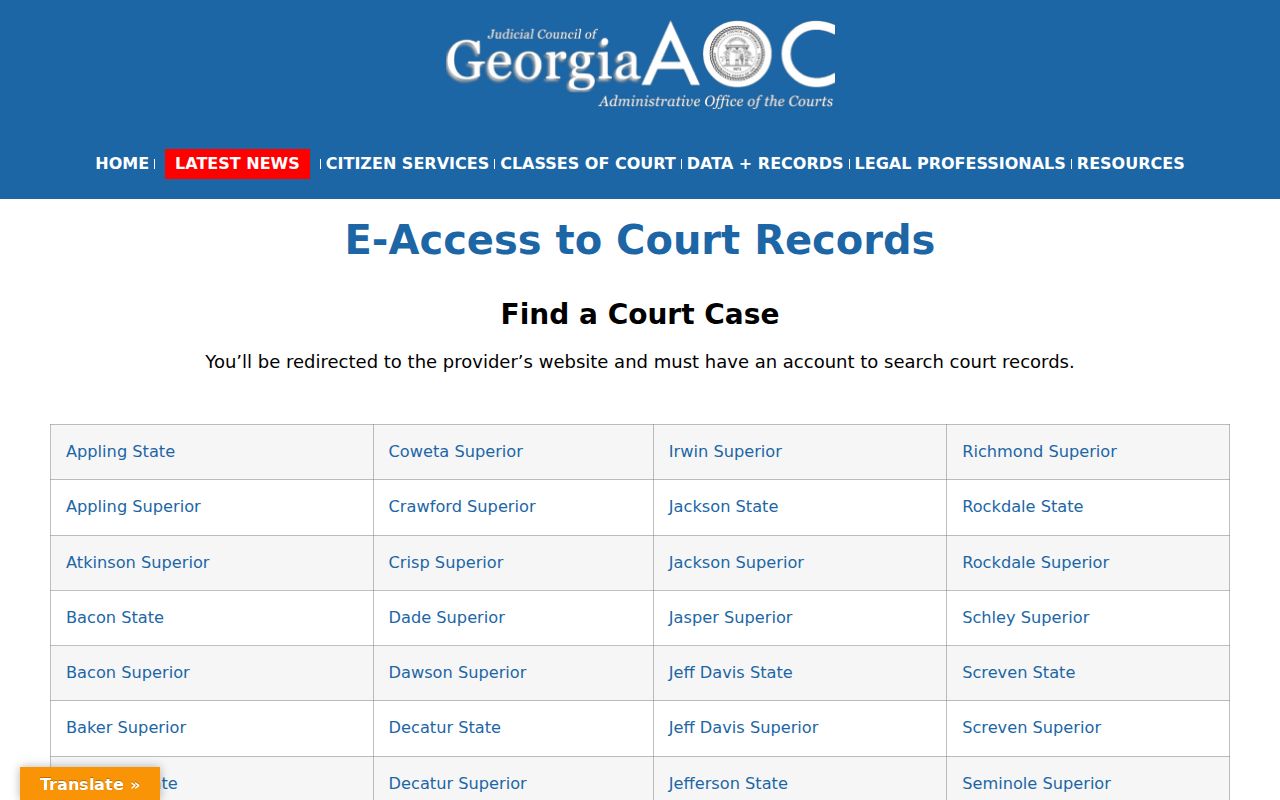
Catoosa County's clerk remains the authority when a portal summary and the signed court record appear to differ.
Case Record Access & Restrictions
Public access does not remove every legal limit. Juvenile records fall under O.C.G.A. § 15-11-700 and related provisions. Sealed court records, victim details, Social Security numbers, full sensitive identifiers, and protected material should not appear in a public view. A docket may show only metadata for a filing, while the document itself requires a clerk request or remains unavailable.
The Georgia Open Records Act governs many executive-branch records, but court files are judicial records also controlled by court rules, orders, and sealing law. A sheriff request cannot force a clerk to disclose sealed judicial material. When a public Catoosa County case is absent, give the clerk the name, likely court, approximate filing date, and case number if known, then ask whether the record is held elsewhere or subject to an access limit.
Record restriction and court sealing are related but distinct under Georgia law. Restriction changes general noncriminal-justice access to eligible arrest information. Sealing under O.C.G.A. § 35-3-37(m) concerns the court record and requires the legal findings set by statute. A search result that once appeared may therefore change, while authorized justice systems retain information under their own rules.